

Blogs
What Is an LVDT Sensor? Working Principle, Types, and Applications in Precision Gauging
Walk onto any shop floor where tolerances are measured in microns rather than millimeters, and you’ll find an LVDT doing the quiet, unglamorous work of telling machines and inspectors exactly how far off a part really is. It doesn’t show up in marketing brochures the way a shiny new CNC machine does, but if you’ve ever held a bearing race, an automotive shaft, or an aerospace bracket that passed final inspection, chances are an LVDT sensor had something to do with it.
If you work in quality control, manufacturing engineering, or product design, you’ve probably run into the term without necessarily knowing what’s happening inside the sensor itself. This guide breaks down what an LVDT sensor actually is, how it works, the different types you’ll come across, and where it fits into a modern precision gauging setup.
What Is an LVDT Sensor?
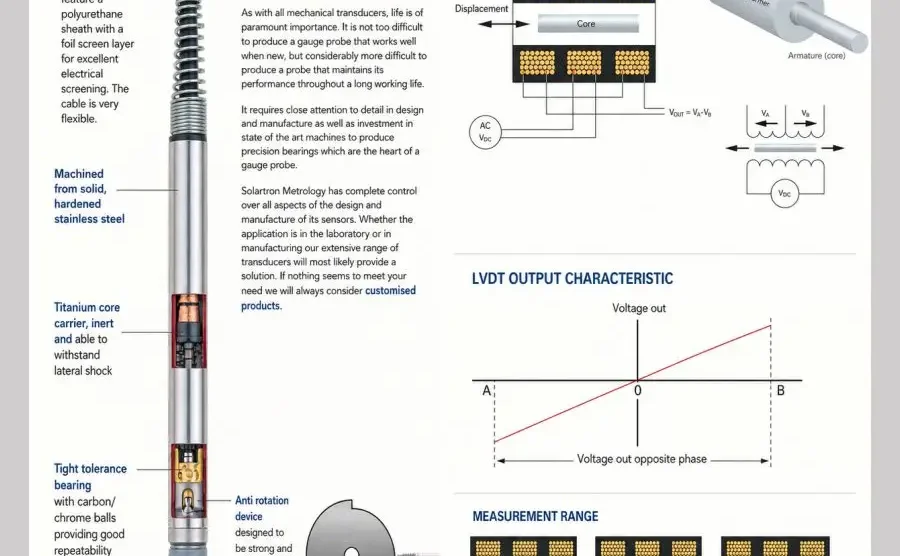
LVDT stands for Linear Variable Differential Transformer. Strip away the jargon and it’s simply a device that converts a small linear movement, sometimes as tiny as a few microns, into an electrical signal that a display or controller can read. Because it does this without any physical contact between moving parts that would cause friction or wear, it holds up to millions of measurement cycles without losing accuracy.
In everyday shop-floor language, people often call it an LVDT probe when it’s the physical tip that touches a part, and an LVDT sensor when referring to the whole measuring element. Either way, it’s one of the most trusted transducers in dimensional metrology, and it’s been that way for decades because nobody has found a simpler, more reliable way to do the same job.
How Does an LVDT Sensor Work?
The construction is elegantly simple, which is part of why LVDTs are so dependable. Inside the sensor housing sit three coils of wire wound around a hollow cylindrical form: one primary coil in the center and two secondary coils positioned symmetrically on either side. A free-moving rod, called the core, made from a magnetically permeable material, slides through the center of this coil assembly.
When an AC excitation voltage is applied to the primary coil, it induces voltage in both secondary coils. As long as the core sits exactly at the center, the voltages in the two secondary coils cancel each other out, and the output is zero. The moment the core shifts, even by a fraction of a millimeter, that balance breaks. One secondary coil picks up a stronger signal than the other, and the difference between them, both in magnitude and phase, tells the system precisely how far the core has moved and in which direction.
That signal then travels to a gauging display or signal conditioner, which converts it into a readable measurement, often shown directly in microns or thousandths of a millimeter on a digital display. Because the measurement is based on electromagnetic coupling rather than mechanical contact between the core and coils, there’s nothing to wear out inside the sensor itself, which is exactly why LVDTs are chosen for high-cycle, repetitive gauging applications.
Types of LVDT Sensors
Not every LVDT looks or behaves the same, and picking the right variant matters more than most people assume.
AC-operated LVDTs need external excitation and demodulation electronics, usually built into a separate signal conditioner. They tend to offer better long-term stability and are the standard choice in fixed gauging stations where the conditioning electronics live in a control panel nearby.
DC-operated LVDTs have the excitation and signal conditioning built directly into the sensor housing, so they simply need a DC power supply and output a straightforward DC signal. They’re more convenient to wire but generally cost more per unit.
Spring-loaded contact probes are the type most commonly used in dimensional gauging stations. A spring pushes the probe tip against the surface being measured, and as the part is loaded or rotated, the core tracks every variation in the surface.
Captive and non-captive armature designs refer to whether the core is mechanically restrained within the housing. Captive versions are more rugged for handling and shock, which matters on a busy production line where probes get bumped constantly.
Versa Controls’ own probe range, including the Analogue and Digital Orbit Series probes, covers most of these configurations, letting engineers match the probe to the application rather than forcing the application to fit whatever probe happens to be on the shelf.
Why LVDT Sensors Matter in Precision Gauging Systems
A single LVDT probe is useful. A bank of them working together inside a multi-gauging fixture is where things get powerful. Picture a fixture built to check a transmission shaft for diameter, length, concentricity, and shoulder position, all in one cycle, as the part sits in the nest for a few seconds. Each dimension gets its own LVDT probe, and all of them feed into a gauging display like Versa Controls SmartGage or NeoGage systems, which combine the readings into a single pass or fail result and log the data for statistical process control.
This is why LVDTs remain the backbone of contact-based multi-gauging even as newer sensing technologies emerge. Their accuracy is well understood, their behavior is predictable across temperature swings, and replacing a worn probe doesn’t mean recalibrating an entire fixture from scratch.
Common Applications
LVDT sensors show up wherever a manufacturer needs repeatable, tight-tolerance dimensional checks:
Automotive: Shaft diameters, gear tooth measurements, valve body bores, and suspension component checks on high-volume lines
Bearing manufacturing: Raceway diameter, groove position, and roundness checks where tolerances are routinely held to a few microns.
Aerospace: Precision-machined structural parts and fittings where a single out-of-tolerance component can ground an inspection.
General engineering: Any high-volume machined component where 100% inspection, rather than sampling, is required to catch defects before they leave the plant.
LVDT vs Other Gauging Technologies
It’s worth knowing when an LVDT isn’t the right tool. Air gauging, for instance, is often preferred for internal bores and blind holes where a contact probe can’t easily reach, or where the part surface is too delicate for repeated physical contact. Piezoelectric sensors bring extremely fast response times for high-speed sorting applications. In practice, most serious gauging setups end up combining technologies rather than relying on just one, which is exactly why gauging displays are built to accept multiple probe types on the same platform.
Choosing the Right LVDT Probe
A few practical questions tend to separate a good LVDT choice from a poor one: What’s the required measuring range, and does the probe’s stroke comfortably cover it without operating at the extreme ends? What accuracy class does the application demand, and does that match the probe’s specified linearity? Will the probe be mounted vertically, horizontally, or at an odd angle that affects spring-loading performance? And finally, does the signal conditioner or display already in use support the probe’s output type, or will additional conditioning hardware be needed?
Getting these questions right at the design stage saves a lot of recalibration headaches later.
LVDT sensors aren’t new technology, but that’s precisely their strength. Decades of industrial use have proven them out in the harshest shop-floor conditions, and their non-contact internal design means they keep performing accurately long after less robust sensors would have failed. Whether you’re building a single-point gauge or a fully automated multi-gauging station, understanding how an LVDT actually works helps you specify the right probe the first time.
Versa Controls designs and manufactures LVDT probes, signal conditioners, and gauging displays in-house, and integrates them into custom multi-gauging systems for automotive, aerospace, and bearing manufacturers. If you’re specifying a new gauging station or replacing aging probes on an existing line, our engineering team can help you match the right sensor to your tolerance and cycle-time requirements.
Frequently Asked Questions
What is an LVDT sensor used for?
An LVDT sensor is used to measure small linear displacements with high accuracy, typically in dimensional gauging, position feedback, and quality inspection applications. Versa Controls uses LVDT sensors in gauging stations that check diameters, lengths, concentricity, and other tight-tolerance features on automotive, aerospace, and bearing components.
How accurate is an LVDT sensor?
LVDT sensors can hold accuracy down to a fraction of a micron, depending on the probe and signal conditioning used. Versa Controls’ LVDT probes and gauging displays are built to maintain that accuracy consistently across long production runs, so readings stay reliable shift after shift rather than drifting over time.
What's the difference between an LVDT sensor and an LVDT probe?
The terms are often used interchangeably, but “LVDT sensor” usually refers to the complete measuring element, while “LVDT probe” refers specifically to the spring-loaded tip that makes contact with the part. Versa Controls manufactures both the probes and the displays that read their output, so the two work together as a matched system.
Can LVDT sensors be used in multi-gauging systems?
Yes, LVDT sensors are one of the most common sensor types used in multi-gauging fixtures, where several probes check different dimensions on the same part simultaneously. Versa Controls builds custom multi-gauging stations that combine LVDT probes with displays like SmartGage and NeoGage to deliver a single pass or fail result per part.
Does Versa Controls manufacture LVDT sensors in-house?
Yes. Versa Controls designs and manufactures its own LVDT probes, including the Analogue and Digital Orbit Series, along with the signal conditioners and gauging displays that pair with them, so customers get a fully compatible measurement system rather than mixing components from multiple vendors.